


Scientific Basis and Research
Precision Sound Medicine
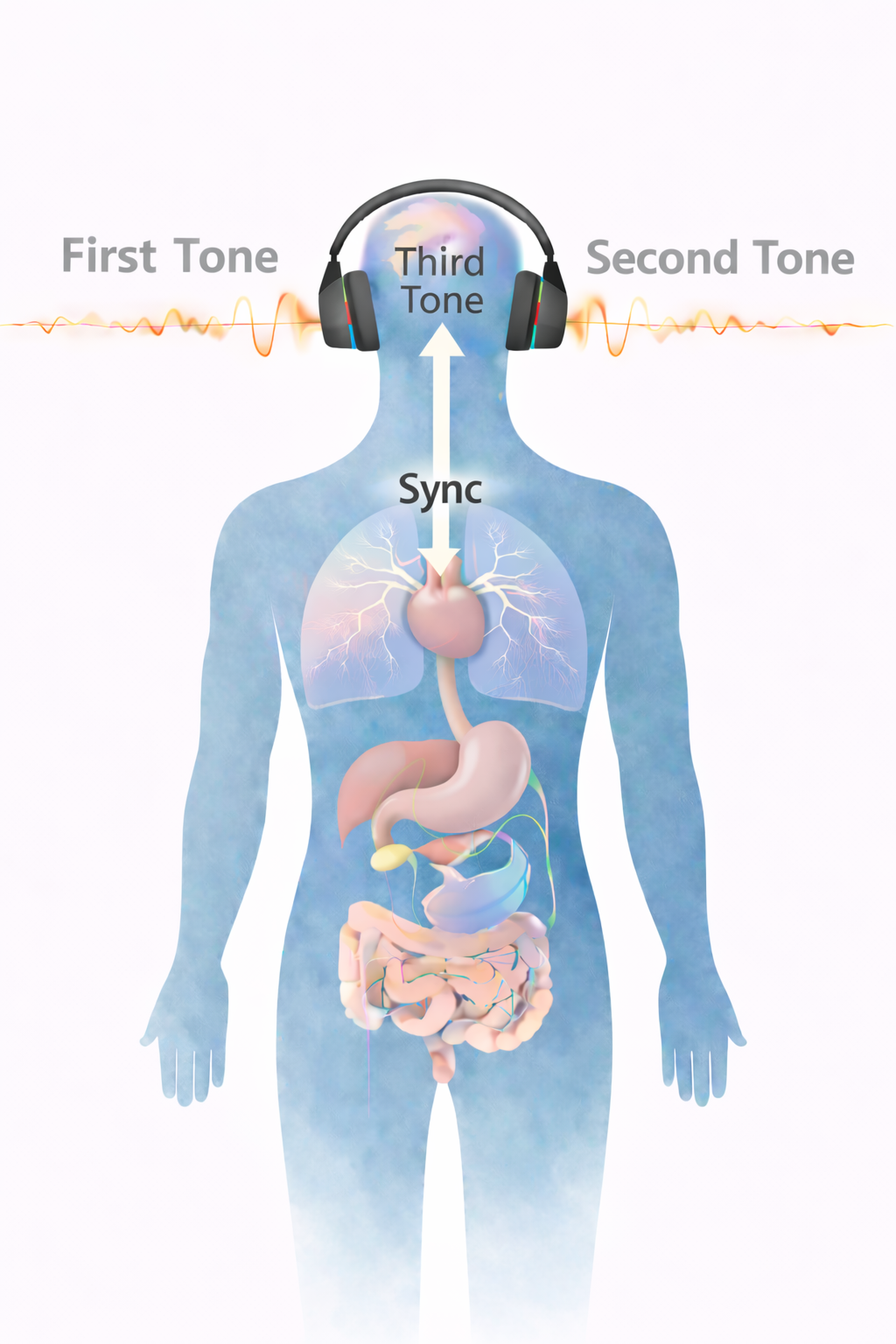
When two closely spaced frequencies are presented simultaneously:
The brain reconciles them into a brainwave state (binaural concept)
Specific organ systems sync with the resulting brainwave state
Physiological and perceptual coherence increase
The ThirdTone App is at the forefront of medicine, delivering:
Original calibrated binaural frequencies from precisely tuned acoustic sources (not AI-generated)
Custom formulas for physical recalibration, emotional wellbeing, and spiritual attunement
Measurable outcomes through neuroscience-backed frequencies and ongoing research partnerships
How ThirdTone Works
Research
-
Brain Body Oscillations
Neuroscientists such as Wolfgang Klimesch are studying how brain frequencies and organ frequencies sync and unsync:
Frequency Architecture of Brain Body Oscillations and Correlation to Sound
Coupling and Decoupling between Brain Body Oscillations
Gut Brain: The Slowest Shared Resonance
-
Brainwave Coherence
Brainwaves function as vectors of consciousness expansion via stacking factors, with lower frequency brainwaves supporting the expansion into higher frequency brainwaves.
High Frequency Phase Synchronization
Universal Pattern of Brainwave Frequencies
Spectrolaminar Patterns Are Ubiquitous Across 14 Cortical Areas
-
Vibrational Medicine
Working with the body’s frequencies by introducing sound frequencies is a growing field that cross-cuts applied neuroscience and the arts.
Impact of Binaural Beats on Mood and Task Performance
Sound Therapy and Brainwave Entrainment
Gamma Stimulation Enhances Glymph Clearance of Amyloid Brain Plaque
Sound therapy and ASD: Auditory Integration Therapy and the Tomatis Listening Method
Existing Research Validates the Mechanism of Binaural Beats.
ThirdTone Advances the Architecture.
ThirdTone is grounded in a growing body of neuroscience research exploring how precisely structured auditory signals influence brain dynamics, cognition, and the autonomic nervous system. While commonly grouped under the category of “binaural beats,” this field is rapidly evolving toward a more nuanced understanding of brain oscillations as interacting, resonant systems.
Existing research demonstrates that simple binaural beats can influence brain activity, connectivity, and cognition. ThirdTone builds on this foundation by introducing multi-frequency, harmonic structures designed to engage the brain as a dynamic oscillatory system.
Neural Difference Tone Generation
The foundation of ThirdTone lies in the well-established phenomenon described in Auditory Beats in the Brain.
When two slightly different frequencies are presented to each ear, the brainstem generates a perceived third tone: the difference between them. This signal is processed in the superior olivary complex and propagated through auditory and cortical pathways.
Hemispheric Synchronization and Coherence
Research such as this paper demonstrates that dissonant frequencies increase synchronization between the left and right hemispheres of the brain.
This coherence emerges specifically in the alpha band and reflects increased communication between auditory cortices.
Rather than simply “entraining” a frequency, the brain appears to be coordinating across regions to integrate the signal.
ThirdTone extends this mechanism by introducing multiple simultaneous relationships, potentially engaging broader and more complex patterns of neural coherence.
Brain Networks Respond as Dynamic Frequency Systems
A key shift in modern neuroscience is the understanding that the brain does not operate in isolated frequencies, but in interacting oscillatory networks.
Studies like this one show that binaural beats can induce:
changes in large-scale brain connectivity
modulation of network-level communication
Similarly, EEG oscillations and cognitive performance demonstrates that cognitive function emerges from relationships between frequency bands, not single frequencies.
ThirdTone is designed explicitly around this principle. We create structured constellations of interacting frequencies, more closely resembling how the brain organizes itself.
Harmonic, Hierarchical Relationships
The work of Wolfgang Klimesch shows that brain function emerges from coupled oscillations organized in harmonic, hierarchical relationships. His model of cross-frequency coupling and oscillatory hierarchy suggests that cognition depends on dynamic interactions between rhythms, providing a framework for understanding how structured auditory input can engage whole-brain networks.
Measurable Cognitive and Behavioral Effects
A number of controlled studies show that binaural beats can influence cognition and perception.
For example:
Binaural auditory beats affect memory and attention found improved working memory performance with beta-frequency stimulation
Binaural beats affect divergent thinking demonstrated effects on creative cognition
Effects of binaural beats on attention and anxiety showed reductions in anxiety
This meta-analysis concludes that binaural beats have small but significant effects across cognition, anxiety, and pain perception.
These findings suggest that auditory frequency relationships can influence not only brain activity, but lived experience.
Autonomic Nervous System Regulation
Binaural beat stimulation has also been shown to affect the balance between sympathetic and parasympathetic activity.
Studies cited in the literature demonstrate changes in:
heart rate variability
stress response
relaxation states
This aligns with the role of the reticular activating system, which links auditory processing to global states of arousal and awareness.
ThirdTone engages this pathway through carefully structured auditory input, supporting shifts in physiological state, not just mental focus.
From Entrainment to Resonance
While early research framed binaural beats as a tool for brainwave entrainment, more recent work suggests a deeper mechanism: resonance.
In this model, the brain is understood as a complex oscillatory system that responds selectively to frequency relationships that match its intrinsic dynamics.
ThirdTone is built on this insight. We create harmonic relationships and emergent tones with which the brain can interact, thus shifting from driving the brain to engaging the brain.
ThirdTone aligns with contemporary neuroscience, which understands the brain as a dynamic, multi-frequency system. Our frequencies engage the brain, organs, and consciousness to recover homeostasis as opposed to forcing alignment.

Ways to Participate
Reach out to learn more about ThirdTone’s ongoing research on brain body oscillations, sound frequencies, and consciousness.
You can be part of our studies and fund our research.